

ESO and OneDose on AI in EMS: A Conversation From ESO Wave 2026
October 26, 2026
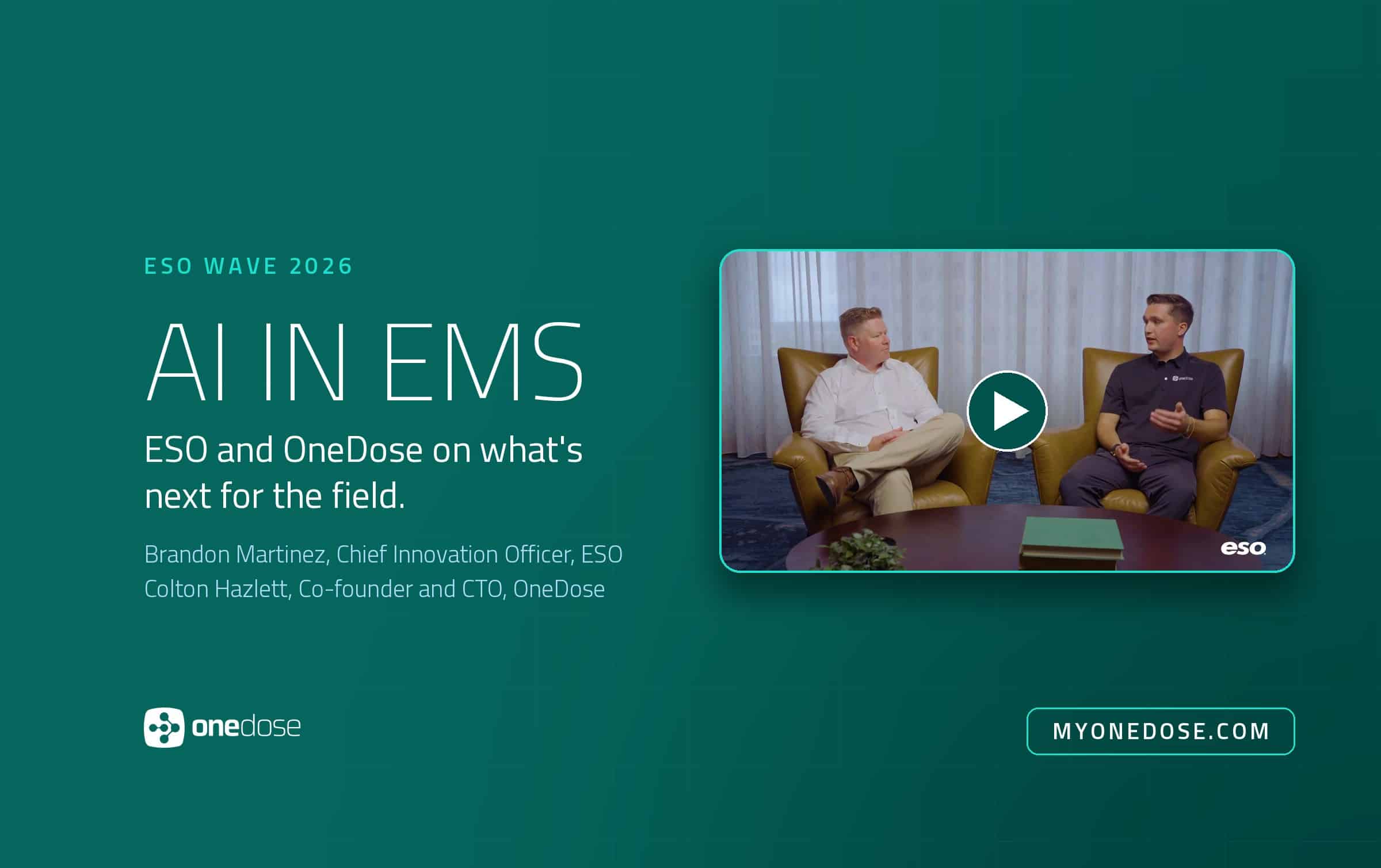
Two builders on where AI fits in the field.
At ESO Wave 2026, Brandon Martinez, Chief Innovation Officer at ESO, sat down with Colton Hazlett, co-founder and CTO of OneDose®, for an on-camera conversation about AI in EMS. They covered how the OneDose and ESO integration works today, why AI in the field has to stay grounded in an agency’s own protocols, what a live, PHI-free patient record makes possible, and the medication safety check Colton is proudest of.
Watch the full conversation below, or jump to the part you care about most.
Recorded at ESO Wave 2026. Video courtesy of ESO.
In this conversation
- 0:43 How the OneDose and ESO integration works
- 1:14 From dosing app to AI-native platform
- 2:16 Voice, APIs and the agentic era
- 4:08 Context management, under the hood
- 4:52 Getting protocols ready for AI
- 5:59 The point of care and the system of record
- 6:41 Live Patient Record
- 8:43 Data and medical direction
- 9:55 What stood out at Wave
- 10:43 Where AI shows up first at ESO
- 12:11 Agents that work across partners
- 13:08 Five years out
- 13:39 Transparency, governance and guardrails
- 14:46 Why EMS, and how fast it’s changing
- 16:01 eMACC and the 2 AM check
Give care in OneDose. Chart in ESO.
Colton opened by giving ESO credit for “one of the most robust APIs that I’ve seen so far in the EMS setting.” That API is what makes the integration possible. Doses, weights and procedures a medic documents in OneDose at the point of care flow into the ESO chart as structured NEMSIS v3.5 data, so crews document once and ESO stays the system of record.
The ESO integration is part of OneDose Premium. See exactly what syncs.
AI that shows where the answer came from
The OneDose AI Assistant launched in April 2026, shortly before Wave. Colton explained why crews can’t just use a general tool like ChatGPT: it “is generically made, so it can hallucinate.”
The AI Assistant answers from your agency’s own protocols and shows where each answer came from. The dosing engine does the math, not the language model. Crews can also log by voice. Say “log my fentanyl administration,” and thanks to the ESO integration it flows into the chart. The AI Assistant requires an internet connection.
Your protocols, ready for AI
Brandon asked how OneDose gets an agency’s protocols, many of them flowcharts, into a form AI can use. “All we need from an agency’s medical direction is their protocol set,” Colton said. OneDose parses the full set, extracts the content, and indexes it in a structure AI agents can read reliably.
Graphical protocols used to be the hard part. Vision models now read complex workflow diagrams and describe them in plain terms, and as Colton put it, “it is incredible how accurate it can get.” The same onboarding puts protocols on every phone with OneDose Essentials, the free EMS protocol app, and most agencies are up and running within a couple of weeks.
A live record that follows the patient
Colton walked through Live Patient Record, which is PHI-free sharing: it captures each intervention as it’s logged. Every device on the call stays in sync, from a medic’s phone to the squad iPad to the Windows Toughbook in the rig. When an agency works closely with its hospital, that record can reach the ED before the patient does.
Brandon connected it to the longitudinal record inside the ESO platform, and to what becomes possible when point-of-care data keeps flowing back into the system of record.
Transparency comes first
AI brings change management with it, and Brandon asked how OneDose helps customers use it the right way. “Transparency is key,” Colton said. OneDose lays out its security, compliance and AI usage for every new customer at onboarding, then trains crews on the do’s and don’ts. Because OneDose is PHI-free, that includes keeping PHI out of the system.
The 2 AM check
Asked what he most wanted people to know about, Colton picked eMACC™, the electronic evolution of the Medication Administration Cross-Check® (MACC): “The ability to digitally verify that the medication that you are about to administer to a patient on those stressful calls, 2 AM in the morning, where you’re coming off that [long] shift.”
When a shortage means the vial on hand isn’t the concentration your dosing setup expects, eMACC catches it. Scan the vial, and it flags the mismatch and recalculates the dose for what was actually scanned. Brandon’s reaction: “That’s very sophisticated, I love it.” eMACC and the OneDose AI Assistant are both EMS World 2026 Innovation Award finalists.
Where AI in EMS goes from here
Both kept coming back to interoperability. “User interfaces, especially with AI capabilities now, can be replicated almost instantly,” Colton said. “It’s the data infrastructure and interoperability that you connect through these partners and these relations that actually defines the true value.” Brandon described ESO’s Project Catalyst as an API-forward technology stack that makes ecosystem integrations like OneDose more seamless.
Already on ESO?
If your agency runs ESO, OneDose can send the weights, medications, infusions and other interventions your crews document at the point of care straight into the chart. See how the integration works, or book a short demo to see it with your own ePCR.
Video transcript
ESO Wave 2026 conversation
Brandon Martinez, Chief Innovation Officer, ESO; Colton Hazlett, Co-founder and CTO, OneDose
Hey, folks. I'm Brandon Martinez. I'm the chief innovation officer here at ESO. Been with the company since 2009. Started off here as a software engineer. Been to every Wave since. So excited to be here at Wave 2026 to introduce Colton from OneDose. We're about to have a really great conversation. So I'm Colton Hazlett. I'm the co-founder and CTO of OneDose, and we're a point of care solution. So we take in your medical direction, and then we custom tailor it to your agency's, medical direction.
We extrapolate your protocols for a quick reference, medication dosages, and a litany of other tools such as the eMACC vial scanner. Great. And OneDose works pretty tightly with ESO. Can you talk to us about the integration, what it does today, where you see it going? Yeah. Big shout out to ESO in developing one of the most robust APIs that I've seen so far in the EMS setting. Because of the way that they did, we've actually been able to get very creative beyond just the clinical push your treatments that you give a medication dose.
We've even been able to integrate it deeply into our checklist. So you can click through your checklist and all of that information flows directly in the ESO. That's fantastic. And so folks today know OneDose for being a dosing application. What do you want to be known for in the next two, three years? So the biggest push that we're gonna be having here soon is we're gonna be an AI native platform. So we've already, just a week ago actually, we just launched our AI assistant.
So with that, you can ask it anything and it's able to extrapolate based on your medical direction along with logging directly into the chart as well. Again, thanks to the ESO integration, anything you can even just say log my fentanyl administration, and it'll flow directly into your chart. That's powerful. So this is a combination of natural language and voice technology that enables that? Yeah. So we... It comes in two platforms. You can do it over chat like your traditional ChatGBT, but the benefit of it is it's all grounded to a source.
So the reason you can't use a ChatGBT is it's generically made, so it can hallucinate. So everything that we've done is to ground it to the source truth level, so you always know that transparency of where this information is coming from. That makes sense, and context is king. So put the guardrails on. And, you know, everybody is moving to more of an agentic era. APIs are probably the tools and the workhorse of that, skill based technology. Do you have any AI strategy you'd like to forecast for us and talk about where maybe some of that technology might find residency within Windows?
Yeah. Part of the biggest thing is really leaning into that voice, portion of it. So the first portion of it that we're launching is just your assistant so you can have a communication with it just to access any of your medical information instantly. But where we see this going is as the APIs get more robust and more robust, the tooling capabilities get, even built out further. Just the interoperability to be able to have that agentic workflow to transfer that information in between and even in a pull push fashion, is where we see this industry really moving.
Yeah, that's great. And, you know, the mantra, APIs over UIs these days is a very real thing, different input modalities change. As you think of where we can improve the APIs and the interoperability, where would you like to see us put our time and attention? The way that I've seen you do it the best is just being transparent about it and really just having, the robust platform for it. Yep. And I think, you know, a lot of the controls, the security of us being in hyperscaler clouds affords us some really powerful integration playbooks.
I think as we bring more AI technologies online, do you see going beyond the mobile app and having other device integrations or hardware partners that also, interrupt with Windows? Absolutely. And that's part of our forecasting on the feature is the actual user interface that people go through isn't the... That's not your moat anymore because user interfaces, especially with AI, capabilities now can be replicated almost instantly. It's the data infrastructure and interoperability that you connect through these partners and these relations that actually defines the true value that they get now.
Yep. As a technologist at heart, I've got to ask you, to the extent you can, talk to us about what's really under the hood. You know, what's the secret sauce? Where are you so excited about where you're placing your bets in terms of your technology strategy? The biggest thing by far is context management. I mean, that's the biggest thing that we've seen in 2026 is being able to, over the period of the time that the people are interfacing with our application, we're having a running context management.
So that actually is context aware before you even ask it a question or interface with our assistant. So that's probably the biggest thing that we see is being able to stay aware of context, managing context, especially in the world of AI. That's interesting. Almost foreshadows an anticipatory element of the platform. Exactly. I like that. Let's go back to protocols for a second. So there's lots of protocols out there, state based protocols, agencies fine tune in their medical direction. How do you, accelerate the ability to ingest and digitize those protocols so they're accessible by AI?
Yeah. So that's part of our secret sauce, honestly, is that we built a very robust AI onboarding process. So all we need from an agency's medical direction is their protocol set. From there, we have a parsing analytics prop. We'll go through the entire protocol stack, extract all the information, and then we index it into a native language that's more understandable for AI agents to move forward in that markdown structure. That makes a lot of sense. And a lot of protocols are graphical in nature.
Has that been a challenge? It has and it hasn't. So the vision models are getting really good at understanding and comprehending complex workflow diagrams. So we're actually able to describe what's going on in the document itself in human terminology just as basic as possible. And it is incredible how accurate it can get. Yeah. That's amazing. And, you know, surfacing that type of intelligence within a system of record like an ePCR, EHR, like ESO, how do you see those integrations evolving over time to bring the best practices of both ecosystem tools together?
Yeah. ESO is a dominant player in the record portion of it, obviously. So... And where we find our secret sauce is right in that real time point of care solution. So being able to have more of a inner interoperability where it can even be split screen embedded into a platform like that is really where we see potentially stuff moving forward. Yeah, that's great. And you know, it doesn't have to be unidirectional, right? Think about the bidirectionality capabilities of both platforms living together in perfect harmony.
What is it that you'd want to see out of the ESO system that would make OneDose even more powerful? Another thing that we just launched actually is called LPR, so Live Patient Record. And what that does, since OneDose is a non-PHI platform, it cannot be identified back to a patient. We've actually been able to document all the interventions that have been given to this patient. Again, it's not directly tied, but having that knowledge in real time can be real updated.
If you work closely with your hospital system, that information can actually get to the hospital prior to them even arriving there. Oh, interesting. So now we're kind of getting into patient movement, logistics, appropriate, you know, dispositioning and triage and routing. So maybe let's unpack that a little more. Can you expand on the capability you're talking about with the, I believe you called the live record? So what we did in OneDesk is, it was kind of a two step process because the first thing that we did is device syncing.
So if two medics are on one shift, they can log in on their personal device, their squad iPad, even their Windows Toughbook at the top of the rig itself too. So beyond that, what we did is we extended that past that. So if you get access to this public record, you can instantly see if I press that I gave fentanyl, you can see that in real time. That's awesome. And it has some synergies with what we call the longitudinal record within the ESO platform.
Being able to project that out, converse with it, interrogate it. And it feels like that's an amazing opportunity to bring these technologies together for the best of both worlds. I'm curious, you know, as you think about other API strategies or partners of interest, where do you see the live patient evolving and becoming even more capable? Yeah. A log left partnering with the ESO and being able to transfer that and actually associate it to a patient. So this is great to see so many different point solutions coming together to really affect in treatment and create better outcomes, always flowing back into the system record and building a rich data tapestry for analytics and insights behind it.
As we think about the data story over time, what is OneDose's take on your data strategy, emergent analytics, or other types of solutions in that space? So where we see the biggest benefit in data is more in that real time medical direction and analyzing that over large datasets to flag where certain people are performing in this way and other people are performing this way, just to bring it into the conversation For the medical direction point of view. That's awesome. And then in terms of the uniqueness of ESO's data asset, which is tens of millions of linked longitudinal outcomes and EMS encounters, how do you think that OneDose would be able to leverage that potentially, either as a research partner or an actual live application, you know, productionized features?
Yeah, so since we have the access to the current medical direction that they have at these agencies, being able to cross reference that over tens of millions of records, as you mentioned, and being able to pull analytics and analyze what has been working and what hasn't, and then be able to back up suggestions to these medical directors and other doctors, clinicians moving forward, I think, is gonna be an amazingly powerful tool. From what you've learned about ESO at the conference, because we're at Wave, what's excited you most about the ESO roadmap or got your wheels turning?
Go back to Project Catalyst. I think that was an incredible project that you guys launched along with that D2I integration. So being able to tie end to end outcomes with the hospitals is going to be absolutely incredibly powerful. That's awesome. And for folks that are just tuning in, Project Catalyst is a next generation technology stack that we envision puts us very much front and center with AI native capabilities, So we can begin to explore new input modalities across our products. And it also opens up opportunities for ecosystem integrations like yourself, making that more seamless, easier, and nimbler to evolve, very much an API forward ecosystem strategy.
So glad to hear that resonated. Is there anything that you'd like to ask me directly and, you know, hear a bit more about my thoughts on any topic we wanna cover, really? Yeah. Seeing how at Wave, the biggest topic coverage was AI and EMS, Where in ESO's roadmap or do you see AI playing first? Yeah. So one of the ways that we've been approaching this from a strategy is both breadth and depth. So being able to put point features into our products.
We started with EMS and trauma, actually, but then laddering up the capabilities over time. So layering voice on top of auto generated narrative, putting ambient listening on top of that. But horizontally, there's a lot of connectivity across our different product ecosystems. So we're talking about EMS, 911 call taking within the CAD systems, all the way to predictions into the hospital. And that's a very healthcare centric view of the world, but obviously we have a huge representation in the FHIR business, which also runs quite a number of medical calls.
So the ability for us to test, explore, and experiment, and get those AI capabilities somewhere in the product with the depth is something that we could then flex over to our other product suites and emulate that same thing with the equivalent infrastructure. So a lot of the technologies that we're seeing announced at Wave have direct applicability, I'd say, to our broader suite. Yeah. And just to second that, I mean, more data is awesome, but unless there's a way that you can empower and actually build intelligence off of that, more data can sometimes not really benefit you in some scenarios, so.
Maybe just a hypothetical, but I love the idea of agents that work not within just a given company's tool set, but work across their ecosystem partners. What workflow opportunities for agentic automation do you see possible with company partnerships like ESO and Windows? Going back to kind of what I was saying on the research front where you can have an agent understand what's happening in real time where all these medical directions, their protocol sets, and what they can actually do, and having to do research based on the records that have happened and the out patient outcomes, especially with your HDE probate, being able to tie the hospital reports to the patient reports to what's being prescribed or recommended in their protocols is a massive area that I see agentic capabilities have Makes a lot of a ton of sense.
Basically, they're proactive on your behalf. They're going to surface the information and insights that are relevant to the current call context, and I think that's a really powerful use case. As we, you know, go five years out, you know, vision casting, crystal ball, where do you think Windows is going to be in five years? Five years is tough to envision with these AI capabilities that are growing rapidly. Where I see us playing the most is becoming a system of record for current protocol medical direction.
That's a big area and being able to, analyze platforms over the longevity of it is a massive area that I see as God. Great. And AI obviously comes with change management for organizations that need to understand explainability, transparency, governance, guardrails, the holster bang. Talk to me about your philosophy and your take on those concepts and how you help to educate your customers about the appropriate use of AI within your systems. Yeah. Transparency is key. So what we've done is we've laid out all of the capabilities, every plat...
Our security, compliance, and our AI usage. And we've detailed that all. So when we bring on a customer, that's the first thing that we cover. So we make sure they're aware of everything that's going on. It's always a resource that they can ask... Answer, moving forward. And then beyond that, is the training and, dos and don'ts, essentially. So since we're a non-PHI platform, don't put any PHI in the system, and similar things like that. Yeah. Perfect. And, you know, as you introduce voice capabilities, it's not up to you for what they say, so you have to be very careful about what you import, what you interpret, and what you store durably.
So these kind of guardrails are essential to have. Maybe two last questions. The first would be, what's got you most excited about coming into work every single day? It's very fulfilling in the EMS industry, especially, when we got into it, which was right around 2020, we, found a need, and the first need was that there was no way to obtain an actual weight in a prehospital setting. So being engineers, we thought that was widely crazy because skills had been invented for the last thirty years.
And then as we get into it more and more, every single year, we see the need of the industry to, and the innovation to catch up with it. And that's incredible to see what's already been happening in the last two years, what's been happening in ESO, what's been happening all around, is just increasing rapidly. The scope of practice is also increasing rapidly for these paramedics. I mean, we talked to some of them thirty years ago could give eight medications, and now they're up to giving like six sixty medications.
So the tools are being created that are also being created in the hospital to enable these providers. Yeah, that's awesome. I think you really hit it on the head. It's kind of living at the frontier of medical practice in the field, pre hospital, and using the technology to its maximum potential to keep pushing the envelope on what we are capable of doing. And I think the last thing I'll ask you is maybe, hopefully, it's a little lay up is there anything that you want to plug about OneDose that we haven't covered so far that you definitely want people to know about?
Probably my favorite thing that we've launched and has been the most impactful already since we launched it is our eMACC process. The ability to digitally verify that the medication that you are about to administer to a patient on those stressful calls, 2AM in the morning, or you're coming off that eighteen hour shift, just to know that what you're giving to the patient is the absolute correct medication. Especially in the instances where there's a concentration shortage, the concentration that you may have in your dosing application isn't perfect.
You scan it recognizes that, alerts you, and then recalculates your medication dosages to the correct amount based off what was scanned. Yep, that's very sophisticated, I love it. Well, thanks for sitting with us today. It was great to meet you. Yeah, Great to meet you too.