

Video transcripts
Council Bluffs Fire Department, Iowa
Capt. Daniel Morse, Training Captain
I'm Dan Morse, training captain here at Council Bluffs Fire Department. We have five fire stations, five engines, two ladder trucks and four ambulances that are staffed 24 hours a day, so our minimum manning is 30 people on duty every day. We run about 12,000 to 13,000 calls per year and transport over 7,000 patients to the hospitals.
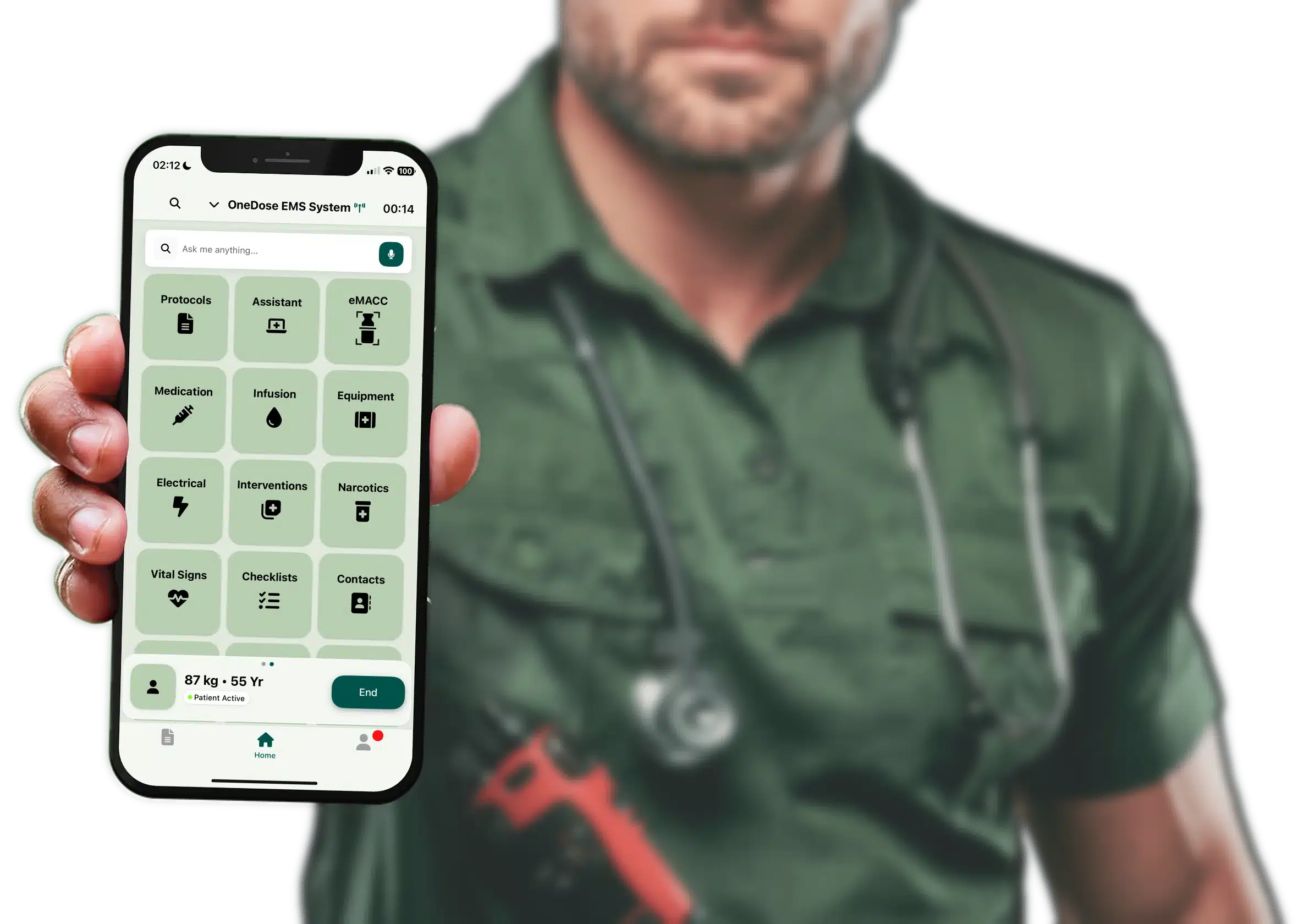
We've been using OneDose for, I want to say, about 18 months now. We needed to make a change to an electronic format that was easily accessible to our members, but also a tool they could actually use, rather than just reading "if I see this, I should do this." What's the actual treatment that we need to do? That's why we were very excited about OneDose. It gives us the ability to see not only what medications I should be using, but it takes out some of the math that may be a problem and may cause medication errors. It allows us to do that math inside the application.
If I had to describe OneDose in one sentence, it would be the modernization of a tool that we've used forever. It's the next progression we need to make to be better practitioners and better providers in the field. If we require every paramedic to be able to do in-their-head calculations on medications, at some point it is going to fail, whether it's fatigue, exhaustion, or we just didn't do the math right. The app gives us the ability to confirm everything we're doing before we do it. Having the ability to change concentrations based on availability saves you a lot of time and reduces your amount of error.
OneDose is that natural evolution in protocol. It's bringing good technology to reduce error. Our paramedics are tired. They're running nonstop, and they're pushing more medications than we've ever pushed. The best treatment for patients is to go to more of that weight-based dosing, not the one-size-fits-all dosing that we've done for 20 years. We need to be more specific to that patient and their needs, but we also have to understand that our paramedics are running double or triple the calls they were 15 years ago. The fatigue is going to happen. Our guys are getting less sleep, and a lot more is expected of them. We need to set them up for success and give them the tools that are going to allow them to confirm what they're doing. That's something we as administrators have to look at: making sure we have the right tools in the hands of our paramedics.
Broken Bow Ambulance Service, Nebraska
Mason Holmes, Supply Officer and Paramedic
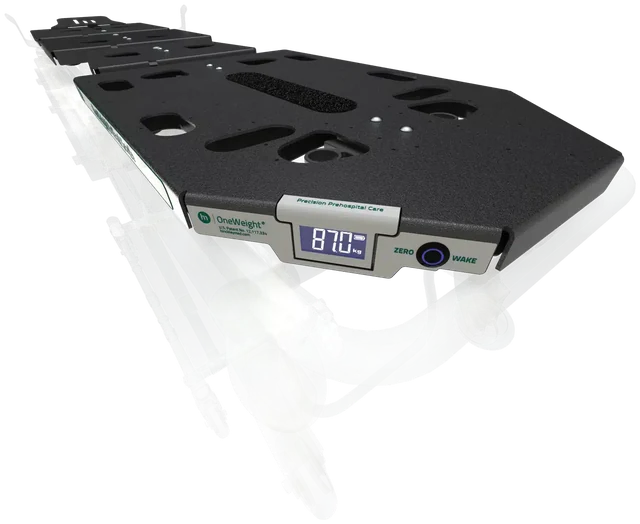
My name is Mason Holmes. I'm a supply officer and paramedic for Broken Bow Ambulance Service. We've been using the OneDose app since Nebraska rolled out the app for the statewide protocols, and we've been using the OneWeight scales for a little over a month now.
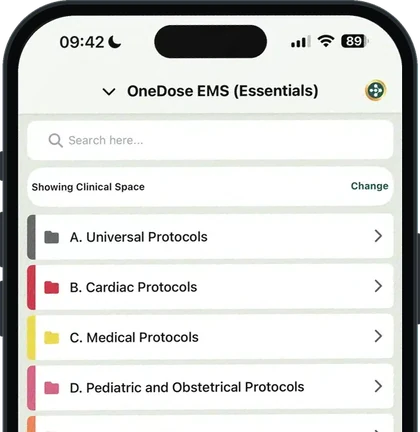
It's exceptionally helpful. Previously in Nebraska, we just had PDFs or printouts, and looking through 300 pages of protocols was very time consuming and not effective. Having OneDose streamlines that process. We can quickly search and find the protocols and tools that we need. It saves a lot of time and helps me have more time with my patient and really focus on patient care, not worrying about protocols or doing dosing calculations on the side, taking away from the actual patient care. We use OneDose on every single call that we go on. We pull it up for reference on the way to the call, or in the moment when we need things.
Now that we have the scale, it's even more beneficial. We're able to have it open and, if nothing else, have the accurate patient weight to give to the hospital, so they have that even before we get there.
What makes me most excited about this tool moving forward is the progressiveness it allows us to have in the field, the accuracy for our patients, and making sure we're doing the right thing every single time for our patients. EMS historically, in my experience, has been pretty reactive and not data-driven. So moving forward, having data to dictate and back up the decisions we make will be immensely beneficial and really help with the progression of EMS nationwide, with implications greater than just here in Broken Bow.
Chimp Haven, Louisiana
Dr. Raven Jackson, Director of Veterinary Care and Attending Veterinarian
Hi, I'm Dr. J. I currently serve as the director of veterinary care and attending veterinarian at Chimp Haven. Chimp Haven currently serves as the world's largest chimpanzee sanctuary. Our mission is to allow chimps to live the chimp life: the ability to make choices, whether they want to be indoors or outdoors, to just be chimps. Overall, our core mission is to provide the best care to chimpanzees in the sanctuary setting and to inspire action for the species worldwide.
A typical day for me as a veterinarian is observing the chimpanzees in their natural environment. I'm looking them over for any signs of distress, any signs of pain, any new injuries, because chimps like to fight. Usually I'm looking to see if anything has occurred overnight that may need medical intervention. Part of that also involves preventive medical care and making sure they get their annual physical examinations, or their examinations according to when they're scheduled.
What we know is that the best thing for another chimp is a chimp. Because of that, we have our chimps in very large, multi-sex social groups. There are boys and girls together, young and old together. That's great for them behaviorally, but it's hard for me as a clinician, because I sometimes have to treat them cage-side, and it can be very difficult if I have to access an individual while they're in that group setting.
Accurate weight measurement and dosing is very important for the chimpanzees, because we use human pharmaceuticals. That means most of our medications are used off-label for the chimpanzee, so it's really important that we have accurate weights so we can get accurate dosing for these individuals.
One of the things Chimp Haven is really proud of is our diverse environments: habitats, different play yards and a lot of space for the chimpanzees to use and exhibit species-typical behaviors. From a clinical perspective, that creates some difficulty. Whenever I'm moving an animal from an outdoor enclosure into one of our clinics, it requires anesthetic use, which is a risk for an aging population. So our goal is to get as many diagnostics as we can in a short period of time, and that's why the OneDose system was really attractive to us.
As the director of veterinary care, I'm always trying to think outside of the box: how can I make the chimpanzees' experiences with the veterinarian seamless and more efficient? One of those things was incorporating our Stryker gurneys into a Stryker van, and it was during that installation and training process that I heard about the OneDose units and scales that were compatible with our Stryker gurneys. That made it very attractive to me, and I wanted to look into it. It seemed like it would help with our efficiency, and we have been using it, and already it's working wonders.
Prior to getting the scales on site, there was a lot of communication with Tristen and Cameron, and the OneDose team has been extremely phenomenal to work with. They answered all of our questions in advance, and when they came on site, it was a very quick install.
The core thing I expect to continue to experience with OneDose and OneWeight is efficiency in our processes. With an aging population, it's really important for us to get the chimpanzees in and out and back into their normal social environments. I would say the OneDose system has readily helped our veterinary technicians. They no longer have to scramble and work out the mathematics. When we prescribe certain medications in the moment, they have that body weight immediately once we have our patient on the gurney, and then the OneDose system pulls up any medication we prescribe during that time period.
Being the director of veterinary care at the world's largest chimpanzee sanctuary, my mind is always on providing the best care to an aging population. I see our relationship with OneDose and the OneDose system doing just that. It keeps our veterinary processes efficient so we can continue to provide the best care to the chimpanzees as they go through the transition of getting older.
University Hospitals, Ohio
Scott Wildenheim, Operations Manager, UH AirMed; Dr. John Hill, EMS Medical Director; Caleb Ferroni, firefighter and paramedic course instructor; Wes Green, EMS Supervisor and fire captain
Hi, I'm Scott Wildenheim. I'm the operations manager for University Hospitals' AirMed critical care transport program, as well as the editor of all of our protocol products.
I'm John Hill. I'm an EMS medical director and a board-certified emergency medicine physician with University Hospitals.
I'm Caleb Ferroni. I work as a career firefighter, and I'm also the instructor for the hospital's paramedic course.
My name is Wes Green. I'm an EMS supervisor and also a fire captain, with about 29 years of experience.
It was almost by accident. Of all people, it started with you. I was at my firehouse and I got a sales call for a product on a scale and some easy protocols. It wasn't even necessarily the protocol end of things. I remember talking with the guy and saying, I don't know that this will fit for us, but something else you mentioned would. Let me run it by some guys that I work with.
John called me and asked if I was interested in this. I had a hundred other things going on. He goes, "Do you want me to watch the video? It looks cool based on the product description and the flyer and some of the tech that was out there." And I'm like, "Yeah, go ahead. Let me know if there's anything there." It turns out there was a lot there. We didn't even know we had a problem.
The problem we actually had at the time was that we couldn't, in a timely fashion, update our app to match our protocol, given how big it is and how many protocol departments we have. How many times did I email one of you and say, I found a problem, a tiny typo or something, and it would be months before we did a revision to correct it? We did have another product solution to put that in app form, but that company essentially re-canned all of our protocols. It wasn't our document. It was a hand revision of our document, which of course led to errors. Even if we changed it, we then had to make sure somebody else changed it somewhere else. It was entirely cumbersome and fraught with error.
I knew we needed it. Once we saw OneDose and what it could do, the big power was instant updates, our own protocol, our own pages. And the kicker was medication dosing: the ability to put something in medics' hands that's going to help them do that med math. That med math is what we all hate to do. We knew we needed it, and then OneDose put it in our hands and said, by the way, you like this app for showing protocols, and we can also do med math and make medication administration much safer than it's been.
Going into OneDose, I didn't have a clue that it had that capability yet. And then when eMACC came out, it was like, now that's really cool. I can use that every day. Through the trials, everywhere I went to do con-ed or anything, I demoed it. I did the same thing with every one of them. I handed it over and said, "Here, use this." "What am I supposed to do?" "I'm not going to tell you. I want to see if you can do this first." Nobody had an issue with it. Nobody.
It was really cool that it doesn't just encompass basics, advanced and paramedics. You also have critical care and flight nurses, EMR, tactical medicine and hazmat. We've got a lot of products in one.
I've told this before. If I've got a pediatric patient coming into the emergency department in extremis, and I know how old the patient is, I literally fire up OneDose on my phone. I put in the patient's age just so I have reference material for things I might need quickly, even as a physician. I was teaching downtown for the pediatric residents, going over some of that with them, and I opened up my own OneDose and they asked, "Can I get that?" I've had that same conversation with pharmacy, because we're talking about rapid responses inside the hospital: can we just use this, even for documenting medication administration?
Two reasons. Customizability: we can use our product the way we want to use it, which is huge. And secondarily, cost. When you're talking about how much this product costs in comparison to its competitors, you're actually getting more for less with OneDose.
John couldn't break it. That's the truth. I tried.
We started our journey with OneDose about a year ago and had great success launching it. It was a fantastic rollout for us. We were involved in the beta for eMACC here at University Hospitals. All of us at the table had the product to play with, and the confidence that when we identify a problem with the app, some math error or whatever, it's a quick, simple phone call to them. "Hey, this isn't working." "It's already fixed." We realized immediately that we could fix on the fly. We know we're going to get reports of things that are wrong or not connecting, but one night we were doing a class and the fixes were in before the class was done. It's amazing. We could probably tell stories all day long about quick fixes we've been able to make.
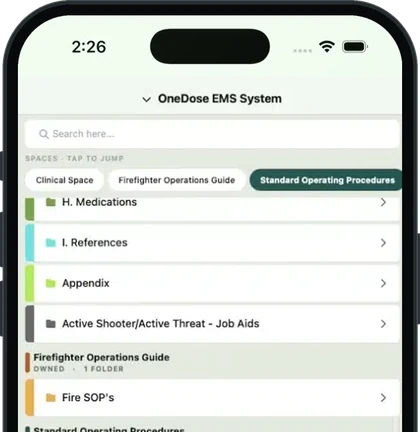
It's everywhere. It's not only our prehospital providers. It's our critical care providers, our tactical medicine providers and our hazmat providers. Every protocol product we had out there was consolidated in there. It also gave us the advantage of putting links to other applications in a standardized place, so people know where to go and can follow that link to use another application. It puts it all in one.
This also fits into the paramedic class. We routinely use this as a research tool for study. "We're going to run drills today on ketamine. Look through your ketamine in OneDose." We're fortunate enough that every one of our students has a student account until they've graduated, so they all have the ability to use OneDose just like us. It works so well.
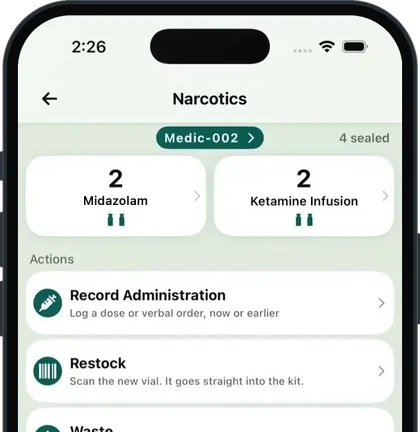
Today we're using it for medication administrations. We're scanning medications and doing that electronic check that we're giving the right medication. I picked up the ondansetron bottle, and that is really what I'm giving to the patient. They didn't change the color of the top. I didn't accidentally pick up the wrong medication. I'm not giving Pitocin to somebody. I'm not giving the wrong med to the right patient. Before OneDose came out with eMACC, what did you do when your EMT or paramedic was driving the ambulance and you were the only person in the back? Now we have the ability to electronically scan and match. Not only is it the right medication, it's the right dosage, the right concentration, and I'm going to be giving the right dose to the patient.
Just last week I took that product to a fire department that runs only fire. They have ALS providers at the department, and I handed them my phone and the drug box and said, "Use this and eMACC." They had no issues using it. It's so easy. It's very intuitive.
eMACC changes the dynamics greatly, in that we go from a passive reference product to it being an active part of the patient encounter. It's no longer just off on the side as decision support. It's now actively checking your decision making and validating your actions. Our in-hospital partners already had this, and we're expanding it into the prehospital setting. One of the people we used for beta testing is also an RN, and he said, "I do this every day in the ER." But who, as a provider at 3:00 a.m., doesn't want that reassurance when you're by yourself in the back of an ambulance with a critical patient and your partner's driving? Why wouldn't you want that reassurance? Scan, and there it is.
Another way we use OneDose is contacts. We all use contacts. We have the ability to contact medical directors in there. Each of the facilities has tags, so we know what capabilities they have. If phones go down, we have the radio channels in there, so crews can quickly tune their radio to contact the hospital or somebody else. Two years ago, before we even knew OneDose existed, we had a situation where our ambulance was transporting a heart attack patient and started off in the wrong direction, because the belief was it was a capable center and it turned out it was not. Now I can just pull it up: I need to go to a STEMI center, and that's the STEMI center.
The biggest thing we're starting to leverage now is notifications inside of OneDose. As a hospital system, we don't dictate what you use for your ePCR platform. We don't dictate what you use for your dispatch software. OneDose has become the one platform we use across our health system, across all of those things, so it's become our one place for notifications. It doesn't get to the agency level and then get lost. It's actually going direct to the provider, and that's absolutely huge. I'm not emailing the chief on a Friday night and it doesn't get to the guys and gals until Monday morning, when the event happened on Saturday or Sunday.
I think it offers something to every group we've deployed it to, which is why we deployed it to all of those groups. I don't know that it benefits any one more than another. Universally, OneDose is a solid product for every level of care we give. All patients benefit. I still think pediatrics probably the most, pediatric and multi-complex patients. Epi doses, for example, probably benefit from this because it breaks it down so easily. No more are we worried about doing pressors, because this is so easy. I had a pediatric allergic reaction and I used it for the epi doses. That's easy. The Benadryl, that's easy. It was right there. I also did the sliding scale by age, and then later I asked mom, "What's the weight?" It was almost exactly the estimate, definitely within range.
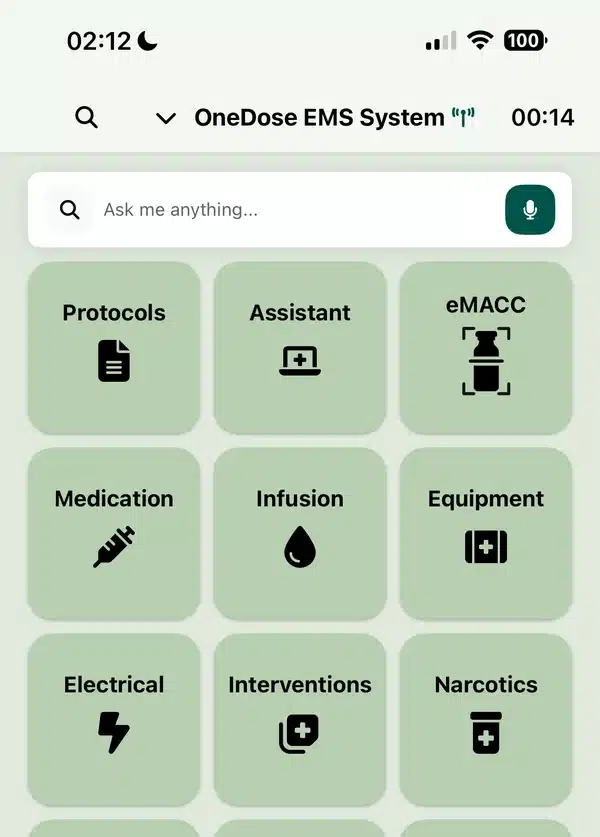
The low-hanging fruit here is instant access to all of the medication reference. Whether you search by medication or by protocol, they're tied together, so you're literally just swiping left or right. Let's say it's 3:00 in the morning or you've got tunnel vision. You're on that medication list, and it's listed top to bottom, first through next. I did my epinephrine first. Oh, Benadryl, I give Benadryl too. It's a reminder of the next step and what to give. We're taking passive reference material and making it an active part of our patient experience and our medication management by introducing that scanning and forcing that double check.
We love that my vitals transfer into my ePCR and my EKG transfers automatically into my ePCR. Now my medication administration will transfer right in and be time-stamped.
I think the telling feedback we've gotten is from users of other systems that cost far more money, and they say, "This is my preference. This is the tool I want, and I'm glad you're giving it to us." Some of them also work somewhere else, and it's still their preferred tool. We had a group of people internally that we were talking about moving to another product, and they said, "No, I want to use OneDose. I don't want to use that other product." It's just so easy.
Price? I'm kidding. But that was absolutely part of it initially. It's a business, and there's a financial component to everything we do. In round numbers, it was going to cost us double to do other solutions, with half of the capability. The two things that stand out for me are the ability to make real-time changes and the ability to customize. We're not bracketed in. It's how we want to present the information, but it needs to be easy to use with 5,000 people using it, unbreakable and fixable, because with 5,000 people you're going to get complaints, no matter what product it is. Being able to fix those complaints matters. And honestly, how many complaints do you get? Sporadic. The complaints I get during my con-eds and lectures are little things, and to be honest with you, 99% of the time it's a user problem, and once we work through it, it's not a problem.
One of our biggest considerations when rolling out the Premium product and eMACC was training. We have a great training cycle because we're in our agencies every month doing training, but it meant giving enough lead time to get everyone trained. We shut off the existing tool and said, here's your new tool, and I think we had far more organic uptake than forced.
I think OneDose kind of sells itself. As soon as you put it into someone's hand and say, this is what we're doing now because we think this is a good product, they say, "Oh yeah, this works." If you drilled into the old protocol PDF or the book, this has that in there. It looks exactly the same. The color coding is exactly the same. It's so much easier to use because it looks like the same product they used before.
I think at about the three-month mark is where it really started to settle in. Everybody was talking about it, and I could walk into any space and say, "Show me your OneDose," and they'd have it available. That good interaction with our user base is probably how we got good adoption.
It was the understanding that we could instantaneously address any issues once we deployed it. So I don't think there was much pressure, certainly in my mind, about the rollout, because I knew we could correct, we could manage, and we could change course if we needed to.
In previous years, the PDF document with our protocols was all manually hyperlinked by yours truly, and it took about 60 hours. It was often faster, year over year, to redo all of them than to try to get them to line up with any structural changes in the protocol. Then in this last medical directors' meeting, we went around the room and decided as a group to make a change that affected three protocol pages. We agreed on it and executed on it. The total cumulative elapsed time from when it was decided was probably 12 minutes. Then we followed that up with the notification, which is the huge part: "In this case, advanced EMTs, you're now permitted to do this within our protocol and your scope. Here's the explanation. Reach out to your medical director." Our entire organizational hierarchy knows that change is there.
One story: I got a call from one of our quarterbacks because the phone systems went down at a hospital. The one that happened more recently was because of the weather. CT scanners and MRIs went down at my hospital, so I'm now closed to strokes and traumas, because I can't take care of them. Within minutes, a notification went out: we are on diversion for strokes and traumas. On the flip side, which is probably the bigger problem we have with diversions in general, is when a hospital turns it off. In a morning briefing you hear, "You can't take patients to this hospital," so you avoid it all day long, and now that hospital isn't getting patients and we're overloading other local hospitals unnecessarily. We get the problem fixed in a few hours and a notification goes out: the hospital is back up at normal capacity, and we're open to strokes and traumas. So leveraging notifications to instantaneously put the information we need in front of all those providers is invaluable.
I pulled up an email Wes sent to Scott in July of 2025 and just wanted to pass it along: "I had a nine-month-old anaphylactic reaction yesterday in the firehouse. OneDose to the rescue. It worked great. Used the slider for the nine-month-old drug dose easily. App worked great. Just wanted to pass along good information."
So we're deploying eMACC and all the other Premium features. Obviously eMACC is the big thing. It's honestly revolutionary. It's novel in the prehospital space. The big conversation nationally is going to be medication safety, and I'm happy that we can be one of the leaders in medication safety. It's going to make things better.
Anecdotally, we've not talked about that many medication errors this year. We really haven't. In previous years, there was a section of every medical directors' meeting dedicated to talking about medication errors. We pushed our system and environment as far as we could for safety, moving them into a drug box. But once it comes out of the box, we couldn't control that. We didn't have control over what we affectionately call the last mile. We changed everything we could up to that point, but it was always incumbent on the provider to take the last proper step, and now we're helping them with that too.
If I run eight calls a day that have to do with cardiac or albuterol administration, I'm going to have that down in my mind. If I run them eight times a year, this is that peace of mind to say, I'm just going to scan this and have somebody double-check me.
I'll even go one step further, representing the middle-aged Gen X population, who up until very recently would have much preferred to pick up the protocol book. I've even given up on that. I'm embracing that technological leap, which for our current generation is not a leap. It's an expectation. Even though it's not how I've always done it, it's an easy evolutionary step in today's age.
Any firehouse you go to, if you introduce something new, the older part of that firehouse doesn't want change. A lot of firefighters don't want change. Most of us don't. This is one where I haven't really run into that. It's been a change that's welcomed by almost anybody who uses it. If I'm teaching a CE, I have them follow along in their OneDose: you all get to where I'm at, and we'll talk through it. I haven't had any issues. It works, and it's easy.
And control. That's probably the biggest thing from the admin side. But to be honest with you, if somebody who wasn't familiar with it asked me about it, I would hand them my phone and say, "Come back to me in three minutes." And they would come back and say, "What is this? I want this."
At a high level, it's cost-effective. It has great access and control. It's a truly novel tool in the out-of-hospital space for notifications, protocol management and drugs. Medication scanning is obviously the big talking point now. It does checklists. It does everything you need it to do, and it really is one solution to handle the care of patients safely.
As for the company, not just the app itself, they've worked very well with us. They worked fantastic with us to find solutions to problems we probably didn't even know we had, and they were able to help develop other expanded features. They obviously had the vision to start down this path to begin with, and they did a fine job presenting it to make us aware that it solves problems we didn't know we had and that we could optimize processes. That team is young, they're motivated and they're not afraid to break things, and that has yielded a revolutionary product that, to John's point, is novel in the space and has better feature sets than comparable platforms.
Anytime we go to them with a problem, they often say, "We've already talked about that as needing a solution," or "That's a really good idea. Someone else mentioned that, and we're going to start working on it." So the relationship has been great, because they're not just listening to us. They're listening to other agencies that are guiding them, and we don't necessarily have unique problems. If you had asked me whether I wanted medication scanning, absolutely, and they already had it. They already had a process selected, and they wanted to rely on us because we have 5,000 users. We have the breadth and the volume to put this out there. We were part of the beta test. We weren't the only agency beta testing, but we were the biggest agency beta testing, to really kick the tires and make sure the product would be ready to go. And to their credit, the turnaround from deciding to do it, to beta testing, to deployment was less than a year. No other organization or company I've worked with has gone from a new feature idea to production in that short a time. Not in the IT space, and not in the SaaS space, for sure.
To toot our own horn, contact tagging was our idea. Color coding was our idea. eMACC was not our idea, but we love it. When they rolled out EMS calculators, we were a part of that and gave them ideas for which EMS calculators we would want.
Just to wrap up, OneDose scratches a definite itch for me as an IT geek. For those who don't know, my prior history was in information technology. I was a full-stack web developer for about a decade before going into medicine. I still find technology very interesting. The marriage of medicine and technology is fun for me. That's where I really like to spread my wings. I couldn't have been more impressed with what they've done, where they're going and what their vision is for the OneDose product. It's absolutely amazing. It has made my job much easier as a medical director. It's made communications better with my squads. It's increased and provided safer care for those patients out in the field. I feel more confident having that tool in your hands to provide better care. I couldn't say enough about OneDose. I'm not paid by them, and I have no financial interest in them, but they're someone I talk a lot about because they're just doing a great job.
Likewise, from the protocol development part of my brain, it's expedited our time to market on all of our protocol products, and I'm looking forward to shortening the deployment times on some of our other smaller products. The administrator part of my brain knows I'm putting a tool out there that's going to help my crews act safely in dire circumstances, bring benefit to the patient, and reduce their stress and their workload. Those are the big takeaways in my mind from what we're doing here.
As an average user, it's the ease of use and the training aspect of it. I use it for my medic classes. I use it for the firehouse CEs all the time. It's just so easy, and it's a great reference tool when you're lying in bed and want to look through your meds. Not all of us are that geeky about it, but I am. It's great seeing all of the feedback. Something's constantly updated, and there's a notification about it. To be able to hand somebody something and say, "Do this," without even telling them how, and they get it like that, that's huge to me. So keep up the good work, OneDose.
“Before we even arrived, we used OneDose to look everything up and confirm dosing. When we got on scene, there was no hesitation, no second-guessing calculations.”
Mason HolmesSupply Officer & Paramedic, Broken Bow Ambulance Service (NE)“Increasing accuracy while simultaneously decreasing cognitive load is a win/win for our team in delivering the advanced next-level care our patients deserve.”
 Marc DollEMS Bureau Chief, St. Charles Fire Department (MO)
“The first system-wide deployment of OneDose across Ohio represents a major advancement in out-of-hospital patient safety.”
 Dr. Donald SpanerChief Medical Officer & EMS Medical Director, University Hospitals