

The OneDose AI Assistant Is Here: AI for EMS, Built the Right Way
April 2, 2026
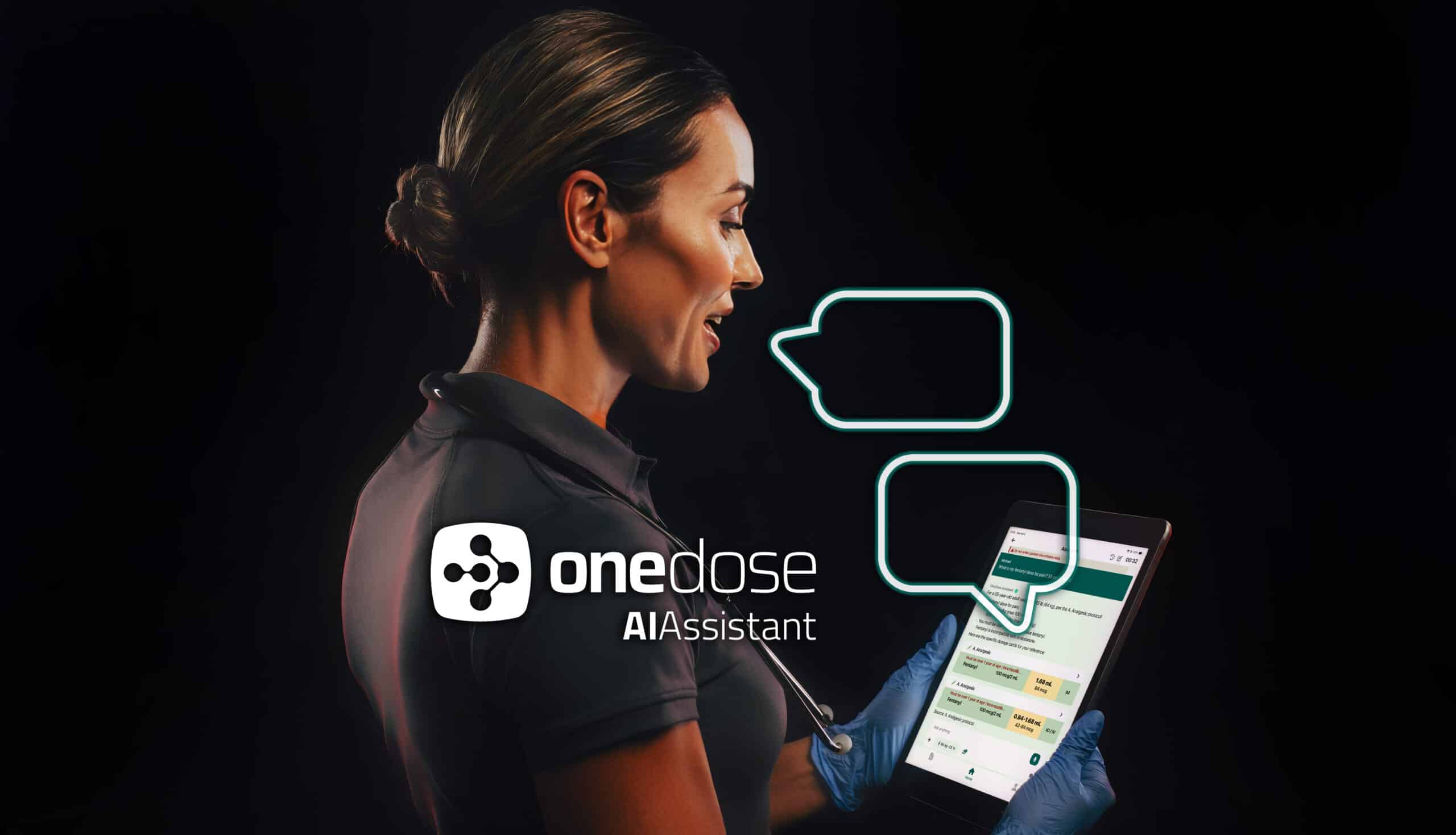
800+ questions. Five agencies. Zero hallucinations from made-up data. This is what happens when you build AI the right way for EMS.
Your medic is on scene with a 55-year-old male in AFib with RVR. Vitals are deteriorating. She knows diltiazem is in the protocol, but the patient’s med list includes metoprolol and verapamil. Is that safe? She could call medical control, wait 45 seconds, maybe 90, probably longer, or she could ask the OneDose AI Assistant and get a protocol-grounded, cited answer in seconds.
That’s not a hypothetical. That’s a real question from a real provider during our live field beta. And it’s one of over 800 clinical questions asked across five EMS agencies that told us exactly what we already believed: EMS providers are hungry for a clinical co-pilot that actually knows their protocols.Today, we’re officially launching the OneDose AI Assistant, a conversational AI clinical decision support tool built directly into the OneDose platform.
Not Another Chatbot. A Protocol Engine.
Let’s be clear about what makes this different from every other AI tool being pitched to healthcare right now.
The OneDose AI Assistant doesn’t guess. It doesn’t pull from the open internet. It doesn’t hallucinate drug doses. Every answer it gives is grounded in your agency’s own protocols, the ones you uploaded, the ones your medical director approved. And when it does math, it doesn’t rely on the AI model to calculate, it pulls directly from the OneDose application’s pre-determined calculations, the same engine that already powers your dosing.That’s the difference between “AI for healthcare” and AI built by people who understand that a wrong answer in the field can have detrimental outcomes.
What Providers Are Actually Asking It
Across our beta with agencies using OneDose, we captured every question. The data paints a clear picture of what providers need in the field, and what they’ve never had access to until now.
35% of questions: Medication dosing and drug reference. The most common queries are exactly what you’d expect, fast, patient-specific dosing. “Medication CrossCheck for my fentanyl dose for pain?” “What are the contraindications for succinylcholine?” “Max ketamine dose for adult behavioral emergency?” Fentanyl and ketamine alone account for over 40% of all these medication queries. And these aren’t simple lookups, providers are asking compound questions with embedded patient context: “What’s my dose for a 62-year-old, 180-pound female?” and “I’ve given my patient two doses of fentanyl for severe musculoskeletal pain and it’s not controlled. What are my options per my analgesic protocol?” The AI understands the protocols and is able to provide real time clinical decision support with information directly from your protocols.
33% of questions: Protocol lookup and clinical decision support. This is where it gets powerful. In live field use, a full third of all questions were clinical reasoning queries, not just “what drug” but “what do I do.” “I’m considering sepsis. What is my criteria?” “ “What is my differential diagnosis for altered mental status?” “What changes in hypothermic cardiac arrest?” These are the questions that delayed care by requiring a call to medical control, flipping through a binder, or just hoping you remembered from your last CE. Now they get answered in seconds, grounded in your protocols.
Here’s what’s significant: this category was higher in live field use (33%) than in benchmark testing (28%). As providers got comfortable with the assistant, they increasingly used it for active clinical support, not just medication lookups. That’s not a drug reference tool. That’s a clinical decision support system proving itself in the real world.
14% of questions: Patient context and session actions. Providers are using the AI as an active partner on calls, pulling up checklists, logging interventions by voice, adding patient details, and navigating protocols in real time. “Pull up my cardiac arrest checklist.” “Mark that bolus as administered.” “Add a 45kg 16-year-old patient to the session.” This is documentation happening in real time, by voice, while the provider’s hands stay on the patient.
10% of questions: Equipment, sizing, and procedures. “What size iGel do I need for a 30 kg patient?” “Walk me through my adult RSI procedure.” “What’s the defib setting for a 24-pound patient?” Step-by-step procedural walkthroughs, equipment sizing, clinical calculations — the things that matter most on the calls you run least often.8% of questions: Scope of practice and administrative. This one is uniquely EMS, and no general medical AI handles it. “Can I give tetracaine as an EMT?”“Can a paramedic access a PICC line?”“My patient’s family says they’re a DNR, what do I do?” Scope-of-practice questions that vary by certification level and jurisdiction. The OneDose AI Assistant knows the difference
Voice-Driven Documentation: Your Medic’s Hands Stay on the Patient
One of the most requested features we heard during beta, and one of the most impactful, is real-time voice documentation. Providers simply say what they’ve done: medications administered, equipment used, procedures performed. The AI documents it. No typing. No clicking. No looking away from the patient to fill out a screen.
This isn’t just convenient. It’s a fundamental shift in how patient care gets documented in the prehospital environment.
The Error Category No One Else Touches
Here’s why this matters at the system level: the OneDose Medication Safety platform already addresses medication identity errors (eMACC™), dose calculation errors (Dosing CDS), and weight-input errors (OneWeight®). But there’s a fourth category of error, clinical knowledge and judgment errors, that happens before a provider ever reaches for a vial. Choosing the wrong protocol. Missing a contraindication. Failing to consider an alternative diagnosis under stress.
Research tells us these errors are massive and massively underreported. A systematic review found 9.9 safety incidents per 100 EMS encounters, 33 times the rate captured by voluntary reports. [1] Protocol deviations appear in 16% of ALS runs, with over a third classified as serious. [2] A 2025 scoping review identified 28 distinct cognitive biases affecting prehospital critical care decision-making. [3] And the AHRQ estimates 5.7% of all ED visits involve a misdiagnosis, 7.4 million patients a year, with cognitive failures identified in approximately 89% of serious diagnostic error malpractice claims. [4]
The prehospital environment has fewer resources, less clinical support, and higher cognitive load than the ED. The OneDose AI Assistant is the first tool built specifically to address this.
The Numbers
The OneDose AI Assistant prevents an estimated 1.5 to 5.7 clinical knowledge errors per 1,000 ALS calls.† For a 25,000-call system, that translates to 38 to 143 prevented errors annually, the high-severity kind involving contraindication misses, dangerous drug interactions, and wrong-protocol decisions on critically ill patients.
When combined with the full OneDose Medication Safety platform, the ecosystem delivers $20.77 to $117.32 in total savings per ALS call, addressing all four error types in the prehospital medication administration chain. †
Built for the Field. Proven in the Field.
Over 800 questions from real providers at real agencies on real calls. Not a demo. Not a simulation. The OneDose AI Assistant has already been tested where it matters, in the back of an ambulance, on a scene, under pressure.
Your crews deserve better than pocket cards, hold music, and hoping they remember. They deserve a co-pilot that knows their protocols as well as they do, and never forgets.
The OneDose AI Assistant is live. The evolution of EMS begins now.
* Beta usage data from OneDose AI Assistant field deployment across five EMS agencies. N=800+ queries. March 2026.
† OneDose internal error prevention and ROI model. Methodology and assumptions available upon request.
About OneDose
OneDose is an AI-driven EMS platform that seamlessly connects clinical point-of-care solutions—from pre-scene to hospital handoff. By unifying protocols, dosing support, documentation, and real-time clinical tools into a single workflow, OneDose empowers emergency clinicians to deliver faster, safer, and more accurate care, even in the most unpredictable conditions. Learn more at www.myonedose.com
References
[1] O’Connor RE, et al. (2022). A systematic review of prehospital patient safety events and contributing factors. Prehospital Emergency Care, 26(sup1), 100–115. Record review identified 9.9 safety incidents per 100 encounters vs. 0.3 per 100 from voluntary incident reports — a 33-fold gap.
[2] Krentz MJ, Wainscott MP. (1991). Monitoring EMS protocol deviations: A useful quality assurance tool. Annals of Emergency Medicine, 20(12), 1319–1324. N=1,246 ALS runs; 16% had protocol deviations; 38% of deviations classified as serious, 7% as very serious.
[3] Awanzo A, Thompson J. (2025). Cognitive biases in clinical decision-making in prehospital critical care: A scoping review. Scandinavian Journal of Trauma, Resuscitation and Emergency Medicine, 33, 101. 16 articles from 5 countries identified 28 unique cognitive biases including anchoring, framing effect, availability bias, confirmation bias, overconfidence, and premature closure.
[4] Newman-Toker DE, Peterson SM, Badihian S, et al. (2022). Diagnostic Errors in the Emergency Department: A Systematic Review. Comparative Effectiveness Review No. 258. AHRQ Publication No. 22(23)-EHC043. Agency for Healthcare Research and Quality. Estimated 5.7% of ED visits involve at least one diagnostic error (7.4 million annually); 89% of diagnostic error malpractice claims involved failures of clinical decision-making or judgment.
Ready to see AI Assistant in action? Contact sales@myonedose.com to schedule a demo.