

OneDose Launches OneDose Narcotics: EMS Controlled Substance Tracking Built Into the Dose
October 12, 2026
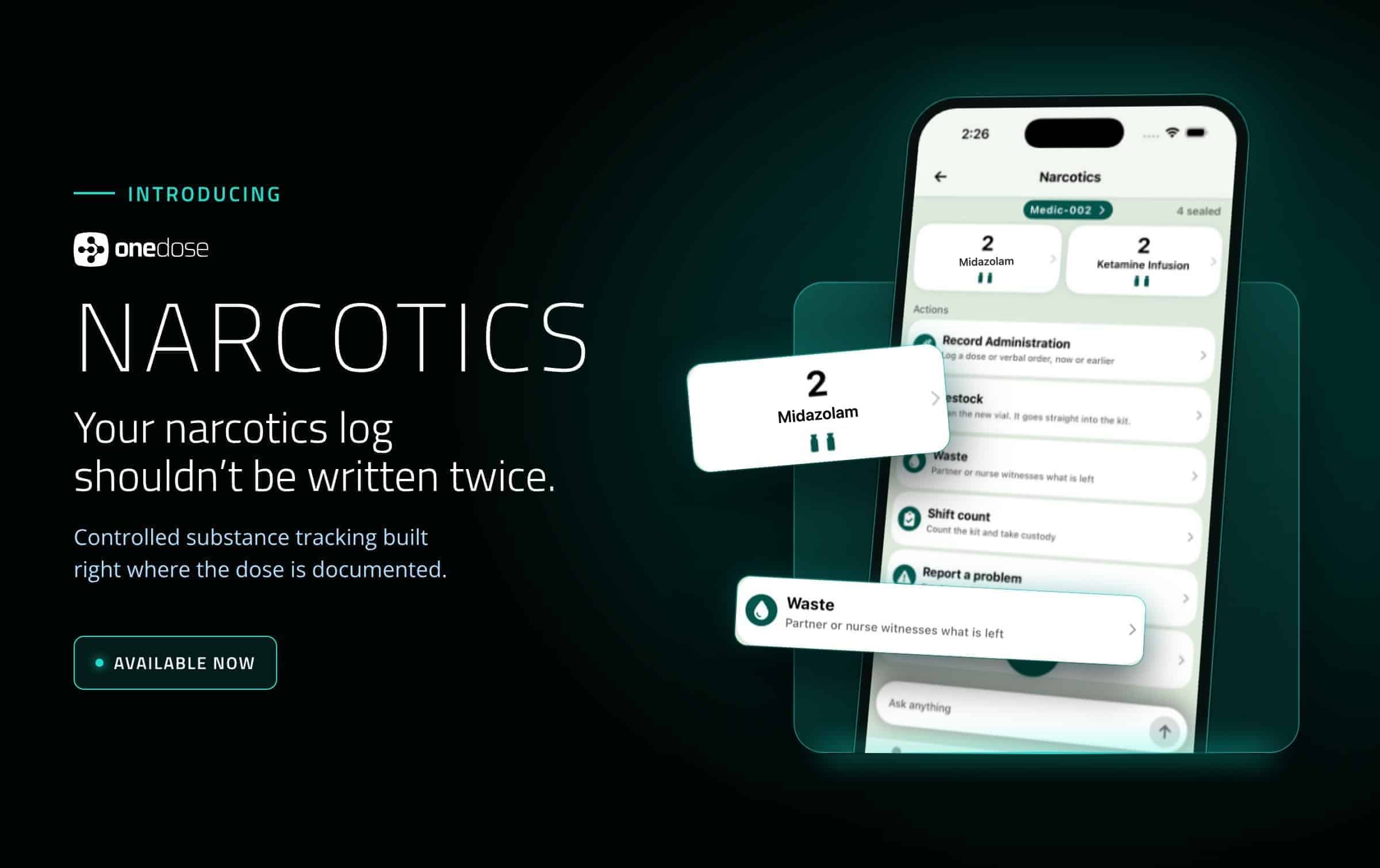
Your narcotics log shouldn’t be written twice.
OneDose® today launched OneDose Narcotics, a new product that builds controlled substance tracking right where the dose is documented. When a medic gives a controlled substance in OneDose, the administration record is written from the dose they just confirmed, and the agency gets a live count for every drug kit, a review queue for anything that doesn’t balance, and inspection-ready reporting, without anyone re-entering after the call what the app already knew.
Live webinar · Wed, Nov 4 · 2:00 PM CT
See OneDose Narcotics live
Join Colton Hazlett, CTO, and Dennis Villone, Director of Product, for a 30-minute walkthrough: a dose, its waste and a restock going from the medic’s phone to the kit’s ledger, and the reports your agency gets for an inspection. Bring your questions for the live Q&A. Can’t make it live? Register and watch the recording on demand.
Since March 9, 2026, the DEA’s recordkeeping rule for EMS agencies (21 CFR 1304.27) has spelled out what must be recorded for every controlled substance dose: the drug, its form, the date, the amount given, the amount disposed of and how, who gave it, who authorized it, and in most states, who witnessed the waste. Most agencies meet that today with a paper log or a separate narcotics app, which means a medic types in after the call what the dosing screen already captured during it. Records written later, from memory, are the ones that go wrong.
How OneDose Narcotics works
A kit is any locked drug box an agency names, on a unit or at a station. Each kit carries a count for every controlled product inside it, and restock, administration, waste and shift counts all move that one balance. Every action is added to the kit’s ledger in order and never edited. A correction is a new entry that points back to the original, and each entry carries a fingerprint of the one before it, so a removed or altered record shows up when the chain is checked.
What field crews get
Medics work the dose exactly as they do today. Whether it comes from a protocol, a medication card or an eMACC™ vial scan, tapping Administer and confirming with Face ID or a PIN writes the administration record. When a dose uses only part of a vial, the remainder is marked to waste, and the waste opens already filled in. The medic records how it was disposed of and picks a witness: a crew partner who confirms with their own PIN, or a hospital nurse recorded by name and role.
At the hospital, restocking is a scan of the replacement vial’s barcode with the same eMACC scanner crews already use, with no labels to buy or apply. Shift counts confirm what is actually in the kit. Records are saved on the device and sent automatically when a connection returns. Agencies using the OneDose AI Assistant can also log a dose and its waste by voice on the way back to the station, and nothing is saved until the medic confirms it.
What administrators get
OneDose Narcotics has its own section in the OneDose Admin Console. Supervisors see every custody event in one list, each kit’s balances, par levels, seal and registrant, and a single review queue for count variances, unwitnessed wastes and records that fall below the agency’s signature policy. Each item is assigned, resolved and kept on the record. For an inspection, the console produces audit packets, an inspection workbook, the DEA Form 106 worksheet, the Form 41 destruction log and the biennial inventory straight from the ledger.
Each agency sets its own policy: which signature methods it accepts from crews and witnesses, shift and two-person counts, whose DEA registration the drugs are held under, the medical director for standing orders, and how long records are kept.
Why it matters
Narcotics moves the OneDose platform from the dose itself to the record behind it. The dosing screen already knows the drug, the concentration the agency configured, the calculated dose, the signed-in provider and the incident number, and when the vial is scanned with eMACC, the exact package. OneDose Narcotics keeps the custody record at that moment instead of asking for it again.
“In the back of the rig, the dose is the record,” said Colton Hazlett, Co-founder and CTO of OneDose. “A medic shouldn’t have to give a dose and then write it down again at the end of the shift, so we built OneDose Narcotics to keep the record at the moment of care. The medic confirms the dose, and the supervisor sees it on the ledger.”
Availability
OneDose Narcotics is available now. Agencies can contact their OneDose representative for pricing. OneDose turns it on for each agency, and every custody action is tied to an individual user account.
OneDose Narcotics is built around the DEA’s EMS recordkeeping rule. Meeting DEA and state requirements remains the responsibility of each registrant, and an agency’s own settings, such as naming a medical director, determine what each record contains. The console prepares the Form 106 worksheet and the destruction log for the registrant to file; nothing is submitted to the DEA or a state automatically. Discrepancies wait in the console’s review queue rather than triggering alerts. Lot and expiration are read automatically from 2D barcodes and typed in for linear ones. No patient name or date of birth enters a narcotics record. Voice logging through the OneDose AI Assistant requires an internet connection.
Frequently asked questions
Do our medics have to open a separate app or screen?
No. The administration is written when the medic taps Administer on the dose they are already giving in OneDose and confirms it. Waste and restock start from the Narcotics tab in the same app.
Nobody has time for this on a high-acuity call. When does it happen?
The administration is written from the dose the medic already gives or scans, so there is nothing extra during the call. The only deliberate step is the waste, which happens afterward. Agencies using the AI Assistant can log it by voice on the way back to the station.
Do we need to label or number every vial?
No. Inventory is counted per product: two fentanyl in the kit at the start of the shift, two at the end, with every event in between on the record. The kit’s seal number is recorded at each count. A vial’s lot, expiration and serial number are recorded when its barcode is a 2D code, and the photo of a scanned vial is attached to the record.
How does a witness confirm a waste?
A crew witness confirms with their own PIN on the medic’s phone. A nurse or clinician at the hospital is recorded by name and role. Your agency decides which confirmation methods it accepts for crew and for witnesses.
Does it file our DEA forms?
The registrant files Form 106 in the DEA’s own system. The console fills in the Form 106 worksheet from your ledger, shows when the one-business-day notice and the 45-day filing are due, and keeps the DEA confirmation number once the form is filed. It also prepares the Form 41 destruction log and the biennial inventory.