

2026 EMS Protocol Survey: What 114 Agencies Told Us About Getting Protocols Into the Field
September 18, 2026
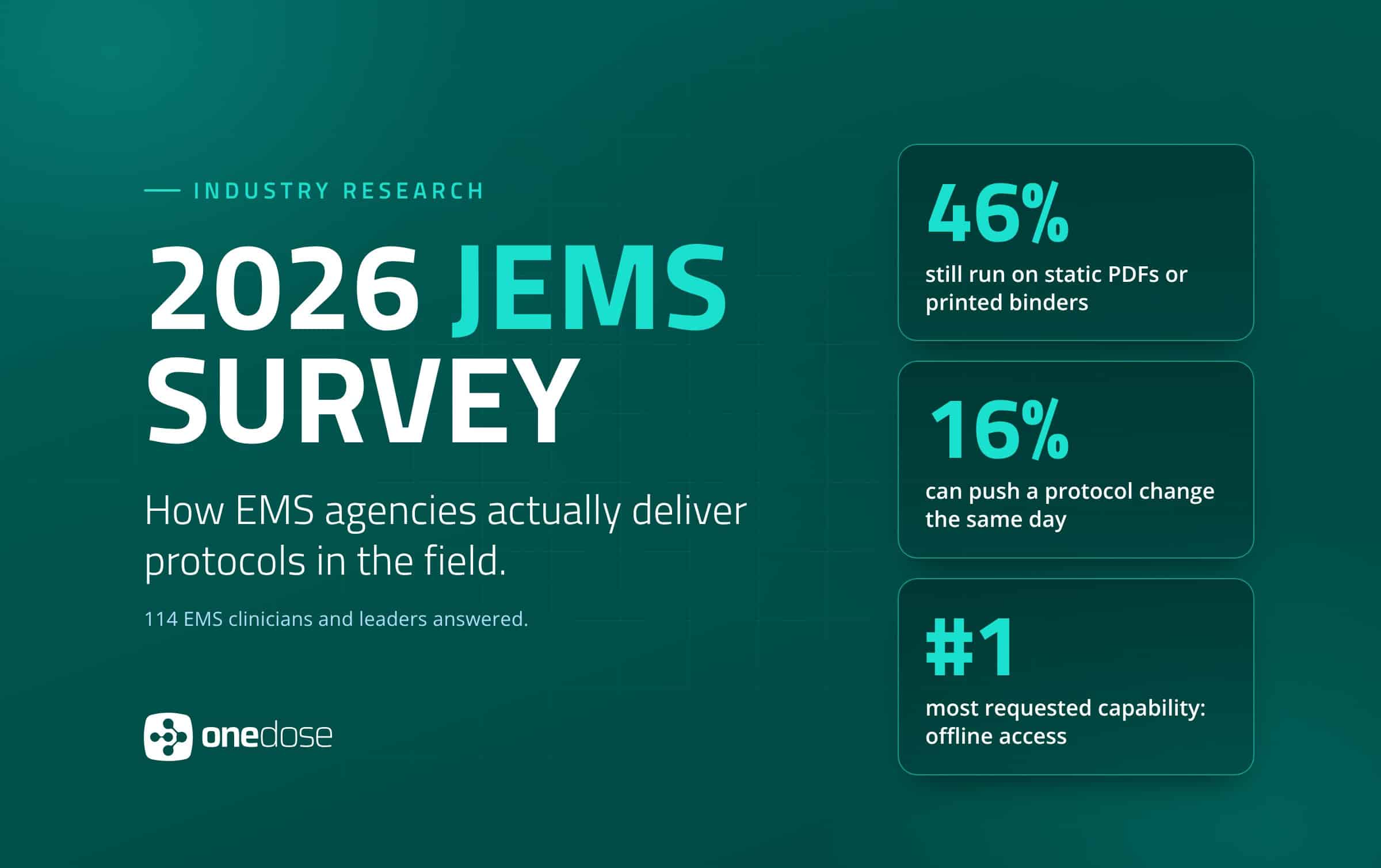
Our 2026 EMS protocol survey: nearly half of agencies still run protocols on paper or PDFs, and only 16% can push a change the same day.
Earlier this year we partnered with JEMS on an independent EMS protocol survey. It asked a deliberately unglamorous question: how do EMS agencies actually get clinical protocols and drug-dosing references into the hands of the people using them?
114 clinicians and leaders across 40 states answered, from fire-based and third-service EMS to hospital systems, volunteer corps, private transport and state coalitions. Roughly seven in ten influence or make purchasing decisions for their agency. Nearly half run under 5,000 calls a year. That matters, because most of the conversation about EMS technology targets the agencies running far more.
The results are worth reading whether or not you are shopping for anything. Five findings stood out.
1. Paper and PDFs still run the field
46% of agencies deliver protocols as a static PDF on a phone or tablet, or as a printed pocket guide and binder. Only 21% use dedicated protocol-management software, and 44% said plainly that they use none at all. Another 11% rely on a reference built into their ePCR. 7% still fall back on verbal medical control or radio consult as their primary method.
This is not a story about agencies being behind. It is a story about a tooling market built largely for big systems. Meanwhile, agencies that never had a budget line for it deliver half the country’s EMS.
2. Offline access beat every other capability, including AI
We asked respondents to pick the single capability they would add to how their agency delivers protocols today. Offline mode that works without cell signal won outright at 25%. The rest of the ranking:
- Real-time updates pushed by medical direction (17%)
- Search by chief complaint (14%)
- A training and quiz mode tied to live protocols (14%)
- A live weight-based dosing calculator (11%)
- Two-way sync with the ePCR (10%)
The friction data says the same thing from the other direction. “Field access on poor cellular or no signal” was the most-cited friction point in the entire survey at 31%. 21 respondents reported both poor signal and a paper or PDF workflow, which is the worst combination of the two.
There is a useful lesson in that ranking for anyone building for this market. A basement, a rural county road and a steel-frame high-rise do not care how good your reference is if it will not open.
3. Almost nobody can confirm who is carrying the current version
This was the finding that surprised us most, and the one with the sharpest edge.
Only 16% of agencies can push a protocol change to every clinician the same day. 18% get there within a week and 25% within a month. 12% take longer than a month. And 19% told us they have no reliable way to know whether the field is carrying the current version at all.
Put together, more than half of agencies either take a month or more to reach confidence, or cannot reach it. Among agencies with no dedicated software, the “we don’t know” figure climbs to 28%.
Worth sitting with: a protocol change usually happens because something clinical needed to change. A medical director who revises a dose, adds a contraindication or swaps a drug during a shortage is making a patient-safety decision. Not being able to verify that the decision reached the field turns a clinical control into an open question. That is a documentation and liability exposure as much as a clinical one.
4. Protocol friction is a retention problem, not just a clinical one
77% of respondents named at least one real friction point their clinicians live with. Only 24% said they were in good shape.
Here is the part worth noticing. “Mental fatigue and burnout” tied with poor signal as the most-cited friction at 31%. It sat in the same list as slow retraining when protocols change (21%), pediatric and weight-based dosing calculation errors (18%), difficulty keeping protocols updated across the agency (18%), and trusting the right reference in a high-acuity moment (17%).
Respondents did not treat cognitive load as separate from tooling. They put them in the same bucket, because that is how it feels on shift. Every unnecessary lookup, every stale binder, every moment of hesitation over which version is current is a small withdrawal from a finite account.
5. A third of the market is actively shopping
In the EMS protocol survey, 34% of agencies said they are evaluating new protocol or clinical-reference tools in the next 12 months. 11% are already shortlisting or piloting; 23% are exploring without a shortlist. 24% are satisfied with what they have, 18% cite no budget, and 24% do not know.
Among the agencies already using a named commercial protocol app, appetite for change was higher, not lower. Being on a tool is not the same as being happy with it.
What OneDose takes from the EMS protocol survey
The clearest read across all five findings is that the protocol itself is rarely the problem. Medical directors write good protocols, and EMS medicine does not lack documentation. The problem is distribution and version control: getting the current protocol into the right hands, at the worst possible moment, in the worst possible conditions.
That is the gap we built OneDose to close, and this EMS protocol survey sharpened our own priorities. The data says three things matter most. The first is offline access to protocols and documents. The second is updates pushed by medical direction with acknowledgment tracking, so an agency can see who has read what. The third is weight-based dosing support in the same workflow. Offline protocols and pushed updates are part of OneDose Essentials, which is free, with unlimited users and no per-seat fees. We made that choice before this survey. The response volume from small and volunteer agencies is a good argument that it was the right one.
We would rather the whole category moved on offline reliability and update verification than that any one vendor did. The 19% who cannot confirm their field has the current protocol is a number the industry should drive to zero. It does not matter who gets the credit.
How the 2026 EMS protocol survey was run
JEMS, a Clarion Events brand, fielded the survey independently between July and August 2026, and OneDose sponsored it. 114 EMS clinicians and leaders across 40 states completed it. Respondent roles included paramedics and EMTs (43%), chiefs, captains and other officers (27%), training officers and EMS coordinators (14%), and medical directors, physicians and nurses (4%). Agency types included fire-based EMS (38%), third-service and municipal EMS (21%), hospital-based EMS (14%), volunteer and non-profit (14%), private and commercial transport (12%), state and regional authorities (6%) and air medical and critical care transport (3%). We rounded percentages and calculated them against all 114 responses. Multi-select questions total more than 100%.
About OneDose
OneDose® is an AI-driven EMS platform that seamlessly connects clinical point-of-care solutions, from pre-scene to hospital handoff. By unifying protocols, dosing support, documentation, and real-time clinical tools into a single workflow, OneDose empowers emergency clinicians to deliver faster, safer, and more accurate care, even in the most unpredictable conditions. 4,000+ EMS agencies across 40+ states trust OneDose. To see how OneDose delivers protocols offline and pushes updates from medical direction with read tracking, book a 30-minute demo.